The Dunkirk Spirit
An unexpected flight in a Lysander
by Trevor Woodgate ARCo Engineer
Having had the good fortune to fly in many different types of aircraft throughout my aviation career my latest flight was something quite extraordinary and provided a very different experience
Whilst at work in the ARCo hangar one Thursday afternoon I was asked by Aerial Collective operations manager, Jack McBride, if I was available for a flight leaving shortly. After accepting the offer I asked what the aircraft would be, “The Lysander” came the reply. How could I possibly refuse!
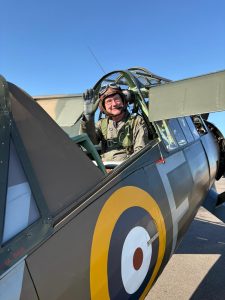
I made my way to the Aerial Collective crew hut and was met by Aerial Collective ground crew Beth Elliott, who kitted me out with a fire-resistant Nomex flight suit and gloves together with a flying helmet. Once ready, Beth escorted me to the aircraft where we met Chief Pilot Jon Gowdy, who gave me a quick brief on the sortie, which was to be in formation with the ARCo camera ship ‘Taz’ a North American T6 Harvard IV flown by Martin ‘Mo’ Overall with Holly Palmer-Davison filming the flight.
The Lysander is a big aeroplane and is quite challenging to climb into using the aircraft footsteps and hand holds. Luckily, Aerial Collective provide a set of steps which makes entry to the observer’s compartment very easy. With assistance from Beth, I donned a parachute and sat down facing backwards on the observer’s seat, which is more of a stool than a seat and put on the lap belt, tightening the straps. Finally, I put the flying helmet on, Beth connected the communications chord and we carried out a comms check. With all satisfactory, Beth closed the canopy, and we were ready to start the engine.
In my headset I could hear Jon going through his pre-start checks; he checked that I was ready and started the engine. The Mercury engine started easily and settled into a slow tick over in order to warm up. The Mercury does not take kindly to mishandling, and throttle movements should be smooth and steady to avoid damage. Engine temperatures also need to be carefully monitored, both oil temperature and cylinder temperature, the latter controlled by careful setting of the cooling gills at the rear of the engine cowling. Once warmed, the engine RPM was increased, and a gentle vibration was felt through the seat which is apparent throughout the flight.
With the chocks removed, we taxied out to a hard standing where engine and propeller operations were checked. With all checks complete, we taxied out to the grass runway for takeoff. After a final check that all was well, the engine RPM was increased and the brakes released. After a fairly short run, the aircraft gracefully rose into the air and we climbed out to operating altitude. During this time the aircraft’s flaps and leading edge slats automatically retract as aircraft attitude changes.
From the observer’s position, the movement of the flaps is seen out of the corner of your eye and will be seen at various times throughout the flight as they automatically move with changes in aircraft attitude.
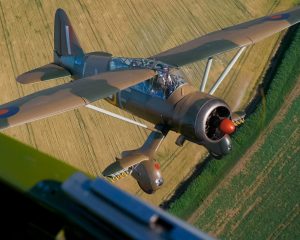
After the excitement of the takeoff, things settle down and one becomes more aware of your surroundings inside the aircraft. A gentle flow of air comes in through the canopy keeping things cool and comfortable; the vibration through the seat is noticeable but not uncomfortable, then a new sensation becomes apparent. As the aircraft is gently buffeted by thermals and gusts of wind, it feels like you are riding on the back of a motorcycle facing backwards and constantly adjusting your position to counter the aircraft’s movement. The hand hold in front of you is akin to handlebars and helps keep you steady on your seat. This keeps you alert throughout the flight but again is not unpleasant.
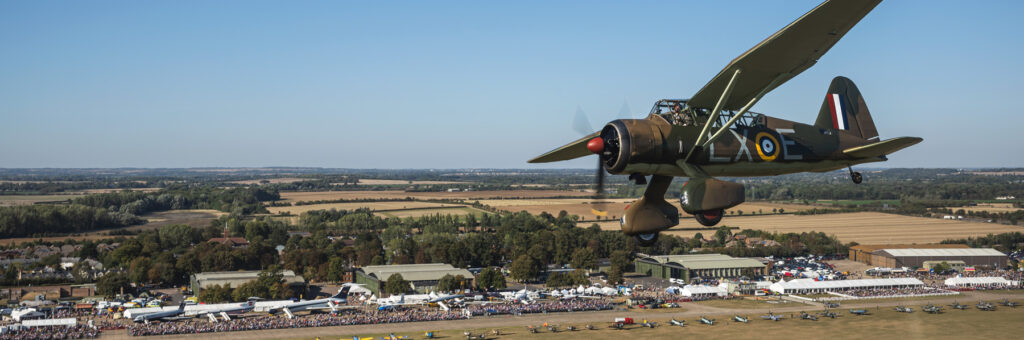
Once I had become settled and comfortable with my environment, my thoughts turned to the role of a Lysander observer during May 1940. The ARCo Lysander is painted in the colours of a 225 Squadron aircraft which operated the Lysander during the Battle of France and the Battle of Britain. Its role would be Army Cooperation which would mean spotting for the artillery, dropping messages, reconnaissance and attacking targets with light bombs which were carried on winglets attached to the undercarriage.
The Lysander also carried two forward-firing Browning .303” machine guns operated by the pilot and a Lewis or Vickers K machine gun operated by the observer. 118 Lysander’s were shot down during May and June 1940 and the aircraft was relegated to dropping supplies to the Allies from UK bases. After the Battle of Britain, the Lysander was used in a variety of roles including air-sea rescue and most famously transporting agents and supplies to and from Europe, a role in which it excelled.
Although a gun is not fitted in the observer’s position, it is easy to imagine scanning the skies through the framed rear canopy which affords a remarkable 180-degree horizontal field of view as well as a good upward view. Fortunately, only our escorting Harvard was spotted on this trip!
As with all flights, this one was over too soon. With the filming complete, Jon took the aircraft back to Duxford, where we turned over the M11 and completed a run and break over the airfield with Jon preparing the aircraft to land after the Harvard. As we approached the grass runway the flaps started to dance beside my head and fully deployed as we touched the runway and settled onto the grass. Jon taxied the aircraft back to the ARCo hangars where he let the Mercury temperatures settle before cutting the engine. Mission complete! As I opened the canopy, Beth appeared with a set of steps and helped me out of my flying helmet and parachute before I exited the observer’s cockpit.
For me, as with many of my flights, it takes a while for the experience to be fully processed but what an experience this was, with a keen interest in the Battle of France and the Battle of Britain, this flight gave me a better appreciation of accounts that I have read in many books.
With thanks to Aerial Collective’s Jack McBride, Beth Elliott and Aerial Collective Chief Pilot
Jon Gowdy
Notes from the Author
I was one of those lucky boys who grew up surrounded by aviation in the 1970’s and 80’s. My father and his friends had created an Aviation Society and Museum, Robertsbridge Aviation Society, and I grew up playing with parts of aircraft, flying with my father’s friends, attending airshows and modelmaking. At the age of 16 I left home to start an apprenticeship with British Aerospace building Harriers and Hawks and left British Aerospace in 2000 with the closure of Dunsfold.
After studying for and gaining CAA Engineering Licences I worked for various General Aviation maintenance companies before settling at Duxford in 2015 first restoring a North American OV10 Bronco. Since then I have been lucky enough to complete a DHC Beaver, DH Puss Moth, Grumman Wildcat and a Boeing Stearman as well as carrying out maintenance on many other types. After a week at Duxford my weekends are spent working maintaining and creating museum displays and managing the day to day running of the Robertsbridge Aviation Society. For me my day job is an extension of my hobby!